
Vitalik Buterin Discusses Ethereum's Transition to a 'Cryptographic World Computer'
Written with artificial intelligence.
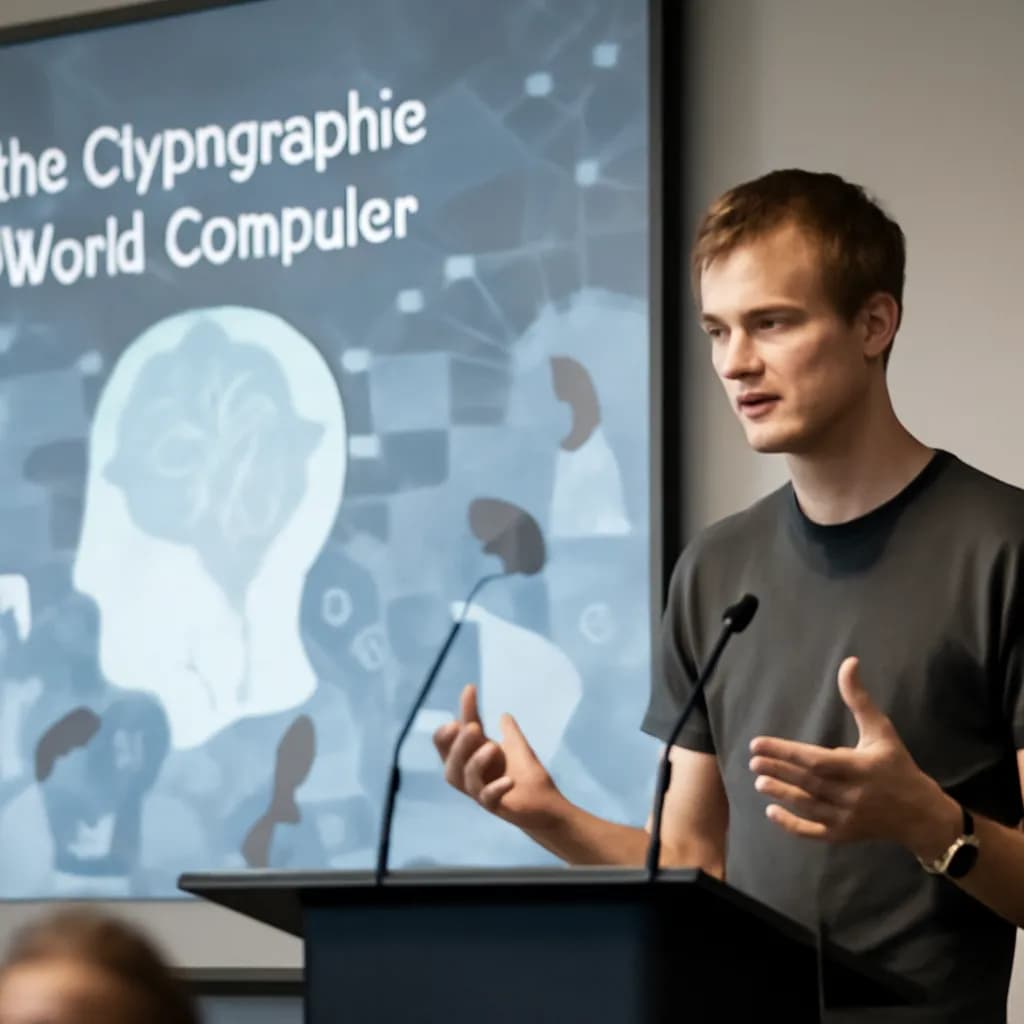
Ethereum co-founder Vitalik Buterin outlined in his recent paper that Ethereum is evolving into a 'cryptographic world computer' that integrates blockchain, cryptographic privacy, and decentralized off-chain components. He anticipates that the upcoming Hegota upgrade may be the last 'traditional' upgrade before a shift toward advanced technologies like recursive STARK and quantum safety.
Evolution of Ethereum
In a paper titled "The cryptographic world computer," Vitalik Buterin, co-founder of Ethereum, discussed the network's transformation from a traditional blockchain. He envisions this evolution as a blend of blockchain technology, cryptographic privacy, validation, and decentralized off-chain components, which he describes as a 'cryptographic world computer.'
Future Upgrades
Buterin suggests that the planned Hegota upgrade, expected to be implemented next year, might mark Ethereum's final 'conventional' upgrade. Post-Hegota, the focus will likely shift toward advanced technologies, including recursive STARK, automated formal verification, highly optimized consensus algorithms, and quantum security.
Changes by 2030
By 2030, Buterin predicts significant changes in Ethereum's block validation process, moving from full downloads and re-executions to SNARK validation and PeerDAS data availability sampling. Additionally, consensus mechanisms will evolve to feature low-latency finality and an optimized Proof of Stake system, allowing for more decentralized block production.
On the user side, enhancements are expected in terms of censorship resistance, privacy, lighter node operation requirements, and reduced confirmation times, with block times of approximately 4 to 8 seconds and final confirmation times of about 8 to 32 seconds. Buterin emphasized that PeerDAS is a crucial step in Ethereum's transition to a more robust system, positioning this shift as a central narrative following the Hegota upgrade.